Ulysses
Ulysses, the legendary Greek hero of Homer's Odyssey, appears in Dante Alighieri's Inferno as a figure of immense intellectual ambition and tragic overreach. Condemned to the eighth circle of Hell among the fraudulent counselors, he is enclosed within a bifurcated flame alongside Diomed, and his account of a final, forbidden voyage beyond the known world becomes one of the poem's most memorable and thematically charged episodes. Ulysses embodies the peril of reason untethered from divine grace, and his story serves as a cautionary tale about the limits of human knowledge and the consequences of pursuing virtue and knowledge without moral or spiritual guidance.
Identity and Background
Ulysses is introduced in Canto XXVI of the Inferno, where Dante and Virgil, standing on the bridge of the eighth bolgia, observe a flame that moves with a divided tip, like the pyre of Eteocles and his brother. Virgil explains that within this flame are tormented Ulysses and Diomed, who together suffer for their shared deceptions: the ambush of the Trojan Horse, which opened the way for the Romans' noble lineage; the cunning that caused Deidamia still to mourn for Achilles; and the theft of the Palladium. Ulysses is thus defined not by his Homeric cunning in isolation but by the specific acts of fraud that Dante's moral system condemns. His punishment is to be eternally wrapped in a tongue of fire, a fitting contrapasso for one who used his eloquence to deceive.
The Final Voyage
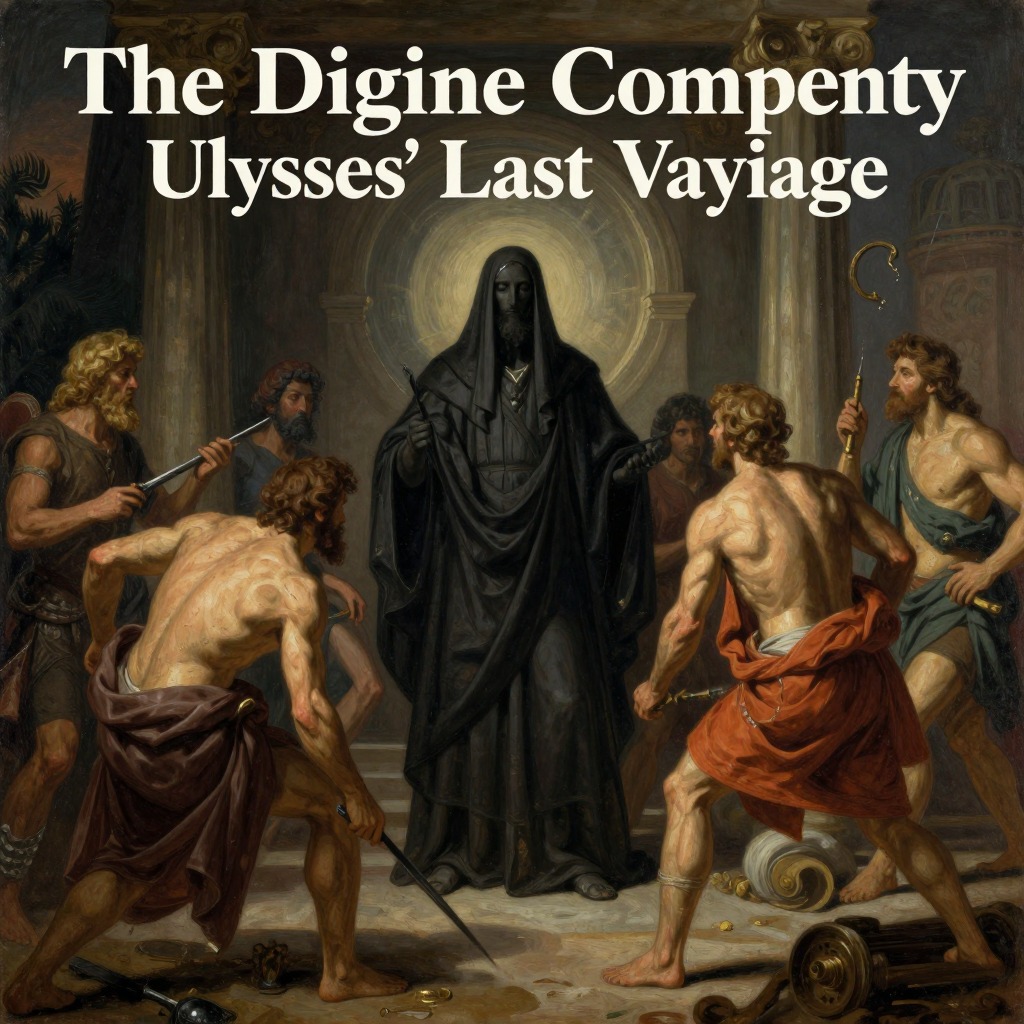
When Virgil, at Dante's request, addresses the flame and asks one of the souls to tell how he met his death, the larger horn of the ancient flame begins to murmur and wave, and then speaks. Ulysses recounts that after departing from Circe, who had detained him for more than a year near Gaeta, neither fondness for his son, reverence for his aged father, nor the due affection for Penelope could overcome his desire to gain experience of the world and of human vice and virtue. He set out on the open sea with a single ship and a small company, sailing past Spain, Morocco, Sardinia, and the other islands of that sea. When he and his crew, now old and slow, reached the narrow passage where Hercules set his landmarks to warn men not to venture further, Ulysses delivered a brief exhortation: "Consider ye the seed from which ye sprang; Ye were not made to live like unto brutes, But for pursuit of virtue and of knowledge." This speech so inflamed his companions that they could hardly be held back. They turned their stern to the morning and made oars into wings for their mad flight, always gaining on the larboard side. After five months of sailing, they sighted a mountain, dim in the distance and higher than any they had ever seen. Joy turned to weeping when a whirlwind rose from the new land, struck the ship's prow, and spun it three times; at the fourth, the stern lifted and the prow plunged downward, as pleased Another, until the sea closed over them.
Thematic Significance
Ulysses' final voyage is a powerful emblem of the Renaissance spirit of exploration and the human thirst for knowledge, but Dante frames it as a tragic transgression. The hero's desire to know the unpeopled world and to pursue virtue and knowledge is, in itself, noble, yet it is undertaken without divine sanction and in defiance of the boundaries set by God. The mountain that appears before the ship is likely Mount Purgatory, which no living mortal may approach except by grace. Ulysses' shipwreck thus represents the inevitable failure of unaided human reason to reach salvation. His story contrasts sharply with Dante's own journey, which is guided by Virgil, Beatrice, and divine grace, and which ultimately leads to the vision of God. Ulysses serves as a warning that the pursuit of knowledge, when severed from faith and humility, ends in destruction. His voice, speaking from the flame, is one of the most haunting in the Inferno, and his account of the "mad flight" has resonated through centuries of literature as a symbol of human ambition and its limits.